Choose a tester for comparison, not a one-number verdict

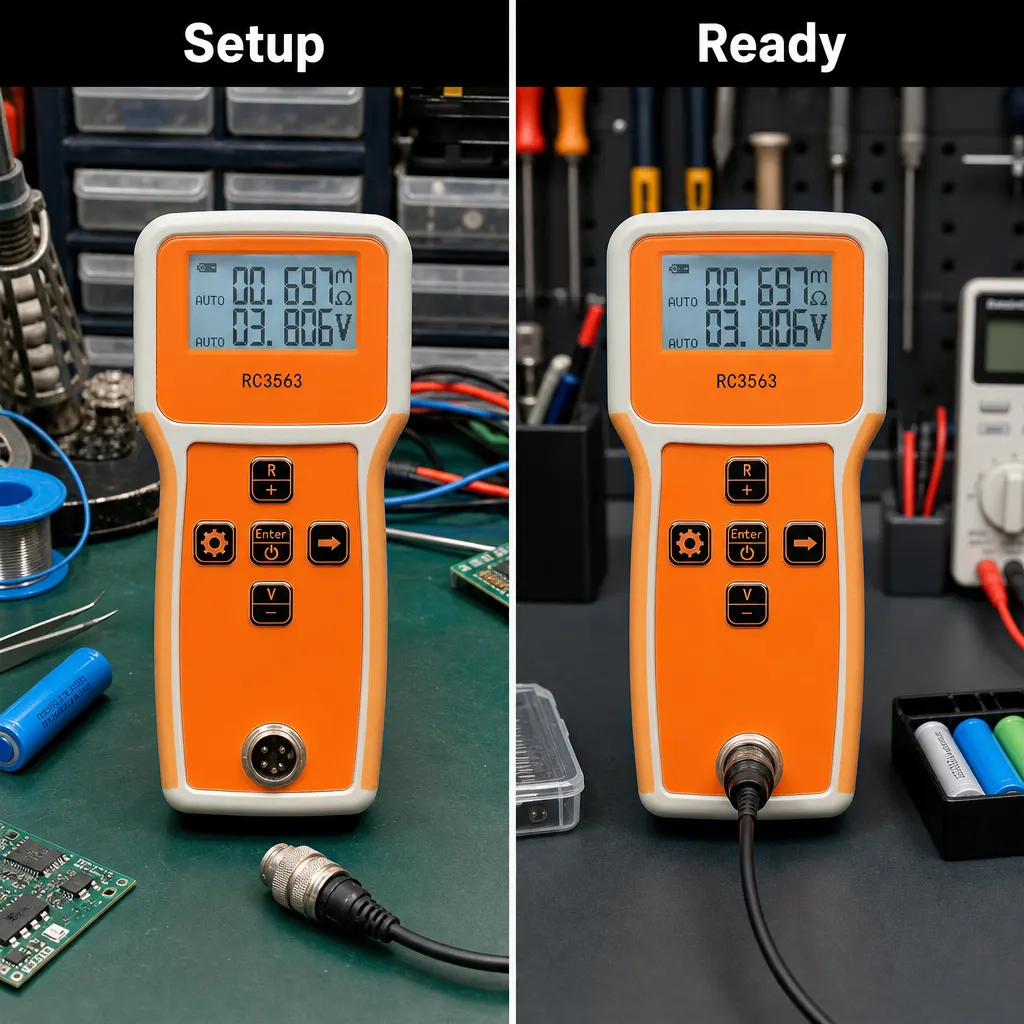
An 18650 internal resistance tester is useful when you need to compare low-resistance readings across a batch of cylindrical cells rather than rely on open-circuit voltage alone. For practical bench sorting, look for a four-wire measurement arrangement, a probe setup that suits exposed cell terminals, and a display that lets you see resistance and voltage without changing instruments. The documented RC3563 configuration is a handheld milliohm tester that measures internal resistance and voltage at the same time and uses a four-wire test clamp to reduce the influence of wire and contact resistance.
The important decision is whether that method fits your actual job. A dedicated tester can help you identify cells whose readings stand apart from otherwise comparable cells, but an internal-resistance result is not presented here as a capacity measurement or a complete assessment of a cell. If your aim is to sort a substantial batch before deciding which cells deserve further investigation, the measurement can add useful evidence. If you only need to check voltage on an occasional cell, the specialist instrument may be more than the task requires.
Set up a repeatable 18650 sorting job at the workshop bench
The typical UK workshop job starts with a mixed group of new, reclaimed or previously used cells spread across a bench. The builder may already have a multimeter or analysing charger, yet still want a more consistent way to compare very small resistance readings. Organisation matters because a useful result has to remain attached to the correct cell. Label the cells before measuring, provide a clear place for recorded figures and keep untested, measured and set-aside cells in separate groups so that an interruption does not undo the work.
Comparison is most meaningful when the cells being considered together are genuinely alike. Keep different cell models, chemistries, ages and known histories separate rather than treating one mixed pile as a single population. State of charge can also complicate an unstructured comparison, so use a consistent batch procedure instead of moving randomly between cells in different conditions. The tester supplies resistance and voltage figures; it does not decide which unrelated cells belong together. That judgement still depends on the builder defining sensible comparison groups before touching the probes.
Check the four-wire method and simultaneous readings
Very small resistance measurements are easily affected by the measuring arrangement. The documented RC3563 uses a four-wire test clamp, with the stated purpose of better avoiding the influence of contact resistance and wire resistance. That is the central fact to check when comparing it with a voltage-only multimeter or with a less clearly documented resistance function. Four-wire measurement does not make contact technique irrelevant, but it is specifically intended to separate the measurement from some of the resistance introduced by ordinary leads and connections.
The instrument is also documented as measuring battery internal resistance and voltage at the same time. On a busy packing bench or electronics workbench, that can make record-keeping more straightforward because both figures can be copied during the same measurement step. The meter has an LCD and an implanted Kalman-filter mathematical algorithm. Those are documented characteristics, but they should not be turned into promises that every displayed number is automatically decisive. Stable handling, a consistent sequence and sensible comparison groups remain necessary if the readings are to support a useful sorting decision.
Confirm that the probe package suits exposed cell terminals
That distinction matters because the supplied information explicitly excludes accessory-only probe and clip rows, as well as other host kits using Kelvin clips or battery fixtures. Do not assume that every listing carrying the RC3563 name contains the same equipment. Before buying, confirm that you are looking at the meter-and-probe package rather than a replacement accessory or a differently equipped kit. A low headline price is not useful if it belongs to a probe without the measuring host.
There is not enough documented detail here to claim a particular holder geometry, probe-tip spacing or hands-free fixture for 18650 cells. Buyers who expect to process a large batch should therefore consider whether loose probing matches their preferred pace and handling method. A fixed battery fixture may sound attractive for repetitive work, but other host kits with battery fixtures are expressly outside this product configuration. If a specific holder is essential, pause and obtain exact package and compatibility details rather than inferring them from generic photographs or from the contents of another RC3563 kit.
Use a consistent label, measure, record and isolate sequence
A practical workbench sequence is: first, divide the cells into like-for-like groups using the information you already know about model, chemistry, age, previous use and state of charge. Second, give every cell a unique label. Third, arrange the bench so the exposed terminals cannot be confused with those of another cell. Fourth, take the voltage and resistance reading with the same probe placement and handling approach each time. Fifth, write both displayed figures beside the cell identifier immediately rather than relying on memory. Finally, move the measured cell to a clearly separate area.
Once a group has been measured, look for repeatability and outliers rather than forcing the results through an unsupported universal pass-or-fail number. If a figure appears unusual, repeat the contact carefully and check whether inconsistent placement or terminal condition may have influenced it. Record the repeated result instead of quietly replacing the first figure. Cells that continue to stand apart can be isolated for further investigation. This procedure turns the meter into a comparison tool and creates an auditable worksheet, while avoiding the claim that one resistance reading proves capacity, suitability or overall battery condition.
Avoid the mismatches that a resistance reading cannot resolve
Do not buy this tester on the assumption that it replaces every other stage of cell assessment. The documented functions are milliohm internal-resistance measurement and simultaneous voltage measurement. No capacity-testing function is stated. If the central question is how much energy a cell can deliver through a charge-discharge cycle, you will still need an appropriate method for answering that separate question. Internal resistance can help highlight differences within a comparable group, but it should not be presented as a direct capacity figure or as a complete judgement of a reclaimed cell.
This product is also a poor match for someone who needs a published resistance threshold that automatically labels every 18650 cell as good or bad. The supplied facts do not provide such a threshold, and cells with different models, histories and conditions should not be collapsed into one arbitrary benchmark. Buyers needing those items should choose according to confirmed contents, not the meter name alone.
Check power, display and bench portability before buying
For use between a workshop bench and another testing location, the RC3563 is described as handheld, lightweight and fitted with a built-in 1000mAh lithium battery. It uses 5V charging, and the product description states that an Android mobile-phone charger can be used. Check the charger and connector requirements against what you already own instead of assuming that every phone charger or cable is interchangeable. No operating-time figure is documented, so the battery capacity should not be translated into a promised number of cells or hours between charges.
The LCD provides the visible measurement interface, while the compact rechargeable format avoids making a mains connection part of every individual reading. That may suit a workshop where cells are sorted in batches or where the meter needs to be moved beside a domestic storage installation. Even so, portability should come after measurement fit. A rechargeable handheld instrument is only the right choice if its probe arrangement, simultaneous voltage-and-resistance display and four-wire method match the cells and workflow you intend to use.
Make a documented host-and-probe check before the next batch
Use this final buying checklist against the actual product description. Package: confirm that it is the RC3563 host-plus-probe SKU, not an accessory-only probe or clip listing. Measurement: confirm simultaneous internal-resistance and voltage measurement. Method: look for the documented four-wire test clamp. Interface: confirm the LCD. Power: confirm the built-in 1000mAh lithium battery and 5V charging. Setup: decide whether a handheld probe arrangement is practical for your 18650 terminals. Limits: accept that no capacity test, universal pass threshold, fixed holder, Kelvin-clip kit or battery fixture is documented for this selected package.
The grounded next step is to write down how many cells you need to process, how you will label them and whether you can probe each terminal consistently at your workshop bench. If that workflow suits a handheld host-plus-probe meter, the RC3563’s documented four-wire resistance measurement and simultaneous voltage display address the central comparison job. If you need automatic capacity testing, a hands-free 18650 fixture or a different clip arrangement, keep looking for a configuration that explicitly documents those requirements rather than trying to make this package perform a job it does not claim to cover.