Choose a tester for comparison, not a one-number verdict

If you are looking for a battery internal resistance tester UK builders can use at the workbench, prioritise a four-wire instrument that measures low resistance and battery voltage together. Use it to compare like-for-like cells under consistent conditions, record the results and isolate obvious outliers for further investigation. Do not treat one resistance reading as proof of capacity, safety or overall battery health. The practical goal is to make cell-to-cell comparisons more repeatable than they would be with improvised leads, a voltage-only multimeter or inconsistent charger readings.
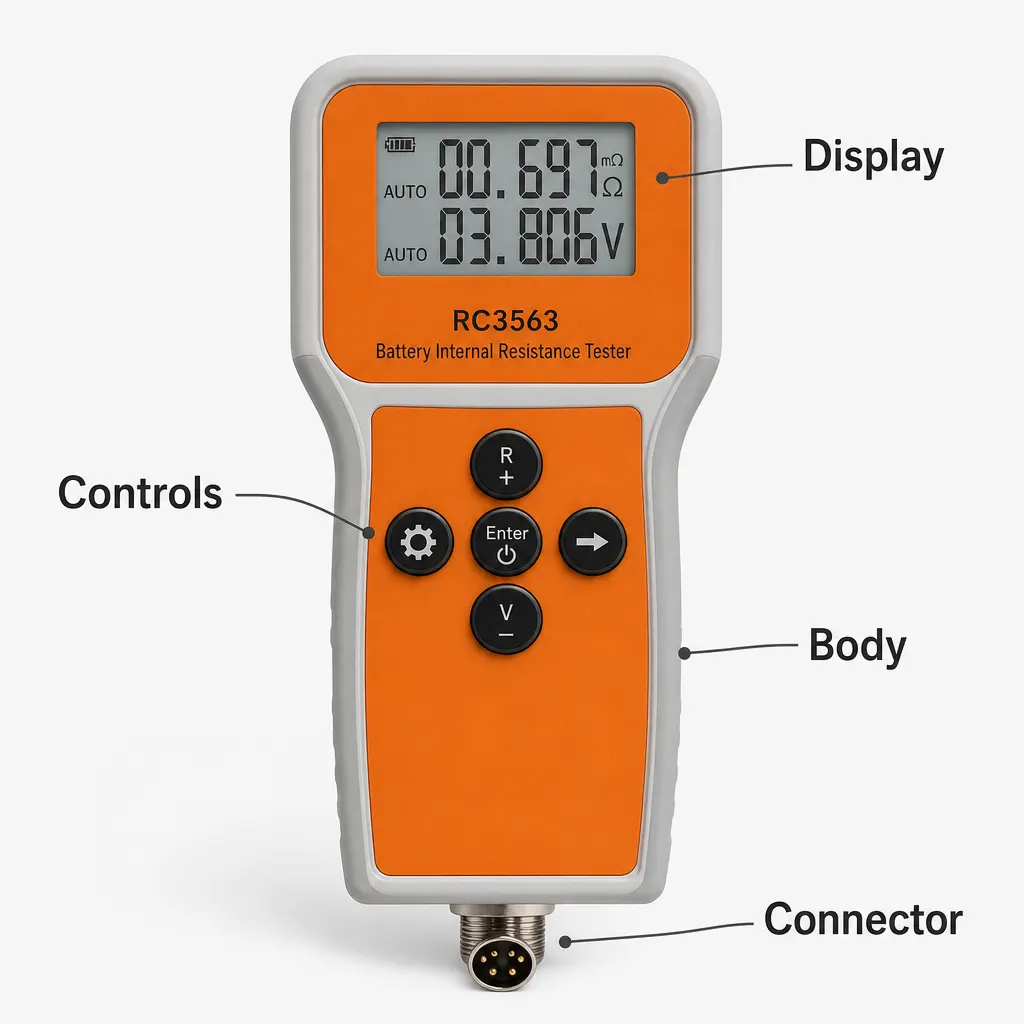
That distinction matters when a batch contains new, reclaimed or previously used cells. Several cells may show similar open-circuit voltage while behaving differently when placed under load, but an internal-resistance measurement is still only one part of the assessment. A dedicated handheld meter such as the RC3563 can display resistance and voltage at the same time and uses a four-wire test arrangement intended to reduce the influence of contact and lead resistance. It is therefore a sorting aid for an organised builder, not a shortcut around capacity checks, load testing or careful pack design.
Set up a repeatable UK workshop sorting station
A useful cell-sorting job starts with the bench rather than the meter. Give each cell a clear identifier before taking readings, and keep untested, tested and isolated cells physically separate. Prepare a simple record with spaces for the cell identifier, voltage, resistance reading and any observation about unstable contact. This prevents two common workshop problems: losing track of a cell after measuring it and allowing one apparently precise number to become detached from the conditions under which it was obtained.
Arrange the bench so exposed terminals cannot be bridged accidentally by loose metal objects or probes. Work with one cell at a time and keep the remaining batch organised away from the immediate measurement area. The selected product is a portable handheld host-plus-probe package, so check that loose probing suits your intended cell terminals and working method. A fixed holder may feel more convenient for a large batch, but the frozen product information does not document a holder or battery fixture in this package. Plan the station around the supplied probe format rather than assuming other accessories are present.
Check the RC3563 measurement method and package
The most relevant documented feature is the four-wire test arrangement. Very small resistance measurements can be affected by the resistance of leads and contacts, so the RC3563 is described as using a four-wire test clamp to reduce those influences. That does not remove the need for consistent technique: terminal condition, probe placement and contact pressure can still affect whether repeated readings settle. The useful buying question is not simply whether the display produces milliohm values, but whether you can establish the same contact method across every comparable cell in the batch.
Confirm the package as carefully as the measuring method. The frozen listing identifies an RC3563 host-plus-probe SKU. Accessory-only probe and clip rows are excluded, as are other host kits fitted with Kelvin clips or battery fixtures. In practical terms, do not rely on photographs or descriptions associated with a different variant. Verify that you are choosing the actual handheld meter with its stated probe arrangement, rather than a replacement accessory or another RC3563 bundle. This is especially important if your preferred workflow depends on clips, a holder or a fixture that is not documented here.
Compare resistance and voltage without inventing a universal pass mark
There is no documented universal resistance threshold in the supplied product facts, and a single pass-or-fail figure would be a poor basis for a mixed batch. Compare cells that are meaningfully alike rather than combining different types into one ranking. Keep chemistry, model, age, prior use and state of charge in mind when forming comparison groups. If those details are unknown, record that uncertainty instead of making the measurement appear more conclusive than it is. The strongest signal at this stage is often an outlier relative to a broadly comparable group, not whether a cell falls on one internet-derived number.
The simultaneous voltage display helps you retain context while taking the low-resistance reading. It does not mean voltage and resistance together reveal every property that matters. A cell may warrant further capacity or load testing even when its bench readings sit near the rest of the group, while an unstable or unexpectedly high resistance result should first prompt a repeated contact check. Record the initial result, reposition the probes consistently and repeat it before moving the cell into an outlier group. Repeatability is more useful than collecting many isolated numbers with changing technique.
Follow a label, measure, repeat and isolate sequence
Use this working sequence at the packing bench or electronics workshop. First, label every cell and divide the batch into like-for-like groups as far as the available history allows. Second, prepare a clear, dry measurement area and remove loose conductive objects from the immediate space. Third, switch on the handheld tester and use the same probe placement and contact approach for each cell. Fourth, record both displayed voltage and resistance against the cell identifier. Fifth, repeat readings that move noticeably or fail to settle before deciding that the cell itself is responsible.
Sixth, place broadly similar results together while keeping conspicuous or repeatedly unstable results in a separate group. Seventh, check that no cell has been moved without its identifier and that every written result belongs to the correct item. Eighth, use resistance sorting to decide which cells deserve further investigation rather than which cells automatically belong in a finished pack. This sequence turns the RC3563 into a comparison tool rather than a verdict machine. It also makes later decisions easier to audit because you can see whether an outlier was repeated and what voltage was displayed alongside it.
Recognise the limits before buying for a battery project
Do not buy this tester expecting it to measure actual cell capacity. The documented functions are internal-resistance and voltage measurement; no charge-discharge capacity test is specified. Builders who need to establish usable capacity will therefore still need an appropriate separate process or instrument. Nor should a resistance reading be presented as a safety certification or proof that a reclaimed cell is suitable for a pack. The product facts make no such claim. It can support screening and comparison, but it cannot replace all the checks involved in assessing, matching or assembling rechargeable cells.
The host-plus-probe arrangement may also be the wrong fit for someone who wants a fixed production-style fixture. Loose probes can suit varied bench access, yet batch work depends heavily on maintaining consistent placement and pressure. If your process requires Kelvin clips, a dedicated cell holder or a battery fixture, those items are not documented as included in this selected package. A standard multimeter may remain sufficient when you only need voltage, while an analysing charger may still be needed for other measurements. This specialist meter makes the most sense when repeatable low-resistance comparison is a genuine gap in your existing setup.
Check power, display and bench practicality
The RC3563 is described as a lightweight handheld instrument with an LCD and intelligent control. Its internal-resistance calculation uses an implanted Kalman filter algorithm, according to the product description. These details may help a buyer who wants a compact dedicated meter rather than a permanently assembled test rig, but they should not distract from the main practical issue: whether the probe format works with the terminals you intend to reach. A readable display and portable body are useful only when the contact method can be applied consistently across the actual cells or installed battery points in your project.
The tester has a built-in 1000mAh lithium battery and uses 5V charging. The description states that an Android mobile-phone charger can be used, although it does not identify a connector standard or document a charger in the package contents. Check the supplied connection and instructions rather than assuming that every phone lead will fit. For workshop planning, charge the meter before beginning a large sorting session and keep your records independent of the instrument. No data logging or automatic transfer function is documented, so prepare to write or enter readings yourself unless the specific supplied instructions state otherwise.
Make the final check against your own cells and workflow
Before choosing this battery tester, write down the exact job it must perform. Confirm that you want simultaneous low-resistance and voltage readings, that four-wire probing addresses the inconsistency you experience with simpler arrangements, and that a handheld host-plus-probe package suits your terminals. Check that you are not expecting documented capacity measurement, a fixed holder, Kelvin clips or a battery fixture. Finally, decide how you will label cells, repeat questionable results and preserve the relationship between each reading and each physical cell. If those steps feel excessive, the instrument may be more specialised than your one-off task requires.
If the fit is sound, the grounded next step is to create a small comparison run before processing the entire batch. Select a few genuinely comparable cells, label them, take resistance and voltage readings with consistent probe placement, and repeat the sequence to see whether your method produces stable results. Refine the bench layout and recording sheet before scaling up. The value of an RC3563 is not that it supplies a magic good-or-bad number; it is that, used methodically, it can help a UK battery builder find relative outliers and decide where further testing effort should go.