Choose the tester that fits your cell-sorting job

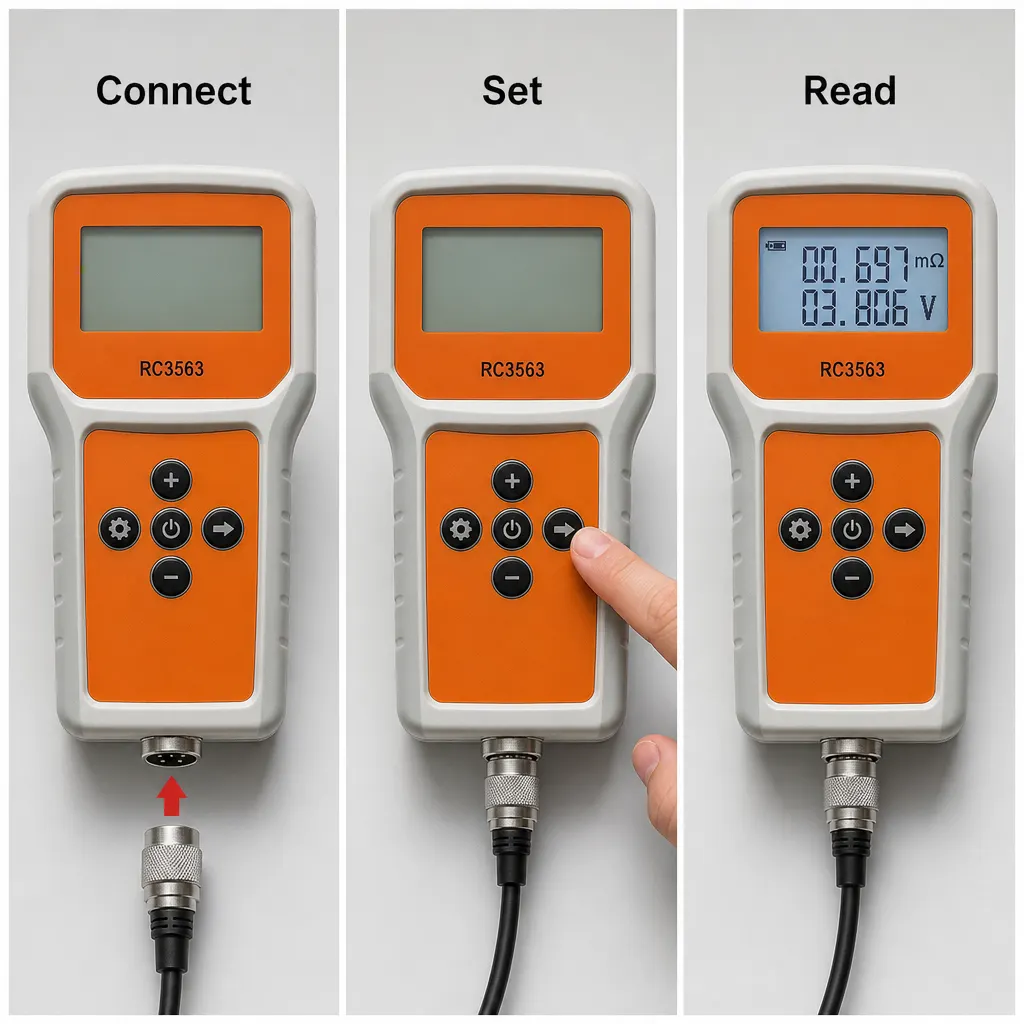
Product use sequence

The best internal resistance tester for lithium cells is a dedicated low-resistance meter that measures cell voltage and internal resistance together, uses a four-wire measurement arrangement, and has probes suited to the terminals you intend to test. For a workshop batch of loose rechargeable cells, the RC3563 host-plus-probe package meets those documented criteria: it is a handheld milliohm tester, displays resistance and voltage, and uses four-wire testing to reduce the influence of contact and wire resistance. Choose it if you need comparative readings at a bench, rather than expecting one measurement to certify a cell.

That distinction matters because the buying decision is not simply about obtaining the lowest-looking number. A useful tester must support a repeatable sorting routine across cells of similar chemistry, model, age and state of charge. It should help you identify obvious outliers and decide which cells deserve further capacity or load testing. Before buying, confirm that loose probes suit your working method and that the selected listing is the complete RC3563 host-plus-probe package. Accessory-only probes, clip sets and alternative host kits are separate arrangements and should not be assumed to be included.

Set up a consistent UK workshop cell-sorting bench

A practical setting is a clear electronics workbench where cells can be labelled, measured, recorded and moved into separate groups without becoming mixed again. This is especially useful when sorting new, reclaimed or previously used cylindrical cells for a home energy-storage, portable-power or workshop battery project. Keep the tester, recording sheet and untested cells in defined positions. Give every cell an identifier before taking readings, because a precise result has little value if it cannot be traced back to the correct cell later.

Consistency at the bench matters because very small resistance comparisons can be affected by how the probes meet the terminals. Terminal condition, contact position and contact pressure should therefore be kept as consistent as practicable across the batch. Do not compare a casually held reading from one cell with a carefully stabilised reading from another. Arrange the work so the probes cannot casually bridge the exposed positive and negative terminals. The handheld format can suit bench work or checks beside an installed domestic storage system, but loose-cell testing still requires deliberate probe placement and an uncluttered surface.

Check the four-wire method and simultaneous readings

The most relevant documented feature of the RC3563 is its four-wire testing arrangement. The product description states that this method is intended to reduce the influence of contact resistance and wire resistance, which is important when the values being compared are very small. This makes the instrument more suitable for low-resistance cell comparison than relying only on an ordinary voltage measurement. It does not mean poor contact becomes irrelevant, however. The operator still needs to use a stable, repeatable technique and question results that change markedly when the probes are repositioned.

The tester also measures internal resistance and battery voltage at the same time. That combination is useful for a batch workflow because both readings can be recorded against one cell identifier without changing instruments between checks. Voltage provides context, while resistance offers another way to compare nominally similar cells. Neither figure should be treated as a complete description of battery condition. The RC3563 also has an LCD and a documented implanted Kalman-filter mathematical algorithm, but those details should support—not replace—careful contact technique, like-for-like comparison and sensible interpretation of changing readings.

Compare like with like instead of chasing one pass figure

There is no documented universal resistance threshold in the supplied product information, so this buying guide cannot give one number that makes every lithium cell good or bad. A more grounded approach is to compare cells that are genuinely alike: the same chemistry, model, approximate age and state of charge. If cells from unrelated groups are mixed together, differences may reflect the cells themselves rather than a simple pass-or-fail condition. Start by establishing the pattern within a comparable batch, then separate conspicuous outliers for investigation instead of discarding them solely because of one unfamiliar figure.

Repeatability is more informative than a single impressive-looking result. If a cell produces a substantially different reading when contact is remade, check the probe position, terminal condition and pressure before drawing a conclusion. Apply the same check to several cells so that the method remains consistent. Record voltage alongside resistance and note any unstable results rather than forcing them into a neat group. This approach uses the tester for what it can reasonably support: comparison and screening. It avoids pretending that the meter supplies a universal health score for every cylindrical lithium cell.

Know where resistance testing stops and further testing begins

An internal-resistance tester does not replace capacity or load testing. The RC3563 is documented as measuring resistance and voltage; it is not documented here as running a charge-discharge capacity test. A cell that sits close to the batch pattern may still need further evaluation before it is selected for a pack. Likewise, an unusual resistance result is a reason to isolate and recheck the cell, not automatic proof of its remaining capacity, suitability or safety. Buyers who want one instrument to perform a complete cell analysis should not assume this host-plus-probe tester fulfils that wider role.

The instrument is therefore best understood as one station in a broader sorting process. It can help reduce a large mixed batch into more meaningful groups and flag cells that deserve closer attention. An analysing charger may still be needed where capacity measurement is part of the builder's process, while load behaviour requires an appropriate separate check. A normal multimeter remains useful for many workshop tasks, but voltage alone does not answer the low-resistance comparison job. Buy a dedicated tester when this additional comparison step justifies the specialist tool and the extra recording work.

Decide whether probes suit the terminals and batch size

The frozen product information identifies the selected item as the RC3563 host-plus-probe package. That package distinction should be checked carefully because accessory-only probe and clip rows are excluded, as are other host kits supplied with Kelvin clips or battery fixtures. Do not infer that every accessory shown across related listings comes in this package. The useful question is whether the supplied probe arrangement is practical for the particular terminals and cell formats on your bench. Loose probes offer placement flexibility, but they also require the operator to reproduce contact position and pressure across repeated measurements.

A fixed holder may appear more convenient when hundreds of identical cylindrical cells are being processed, but a fixture is not documented as part of this selected package. If your preferred workflow depends on a holder or Kelvin clips, this exact host-plus-probe option may be a mismatch. By contrast, it may suit someone who wants a compact dedicated instrument for manually checking mixed cells or reaching terminals that do not fit one fixed fixture. Estimate the number of cells, the accessibility of their terminals and how long manual recording will take before deciding that portability outweighs fixture-based convenience.

Use a repeatable label, measure, record and isolate sequence

Start with a clearly defined batch of comparable cells and assign each one a unique identifier. Arrange the workbench into untested, measured and isolated areas so cells cannot drift back into the wrong group. Check that the RC3563 is charged, as it has a built-in 1000mAh lithium battery and uses 5V charging. Position the probes consistently on each cell, allow the displayed result to settle, and record both voltage and internal resistance against the identifier. If a result appears unstable, remake the contact using the same position and pressure rather than immediately classifying the cell.

Use this working checklist for every batch: confirm similar chemistry, model, age and state of charge; label every cell; inspect the contact surfaces; use the same probe positions; record voltage and resistance together; repeat unstable readings; separate obvious outliers; and reserve final grouping until any required capacity or load checks are complete. Also confirm after the session that no cell has been left unidentified and that unusual readings remain linked to the correct labels. This sequence is more valuable than collecting isolated numbers because it turns the meter into a controlled comparison tool rather than a source of untraceable measurements.

Avoid the common mismatches before buying

Do not buy this tester if your only requirement is a basic cell-voltage check; an existing multimeter may already cover that narrower task. It may also be excessive for a one-off check where no meaningful batch comparison is planned. Conversely, do not choose it under the assumption that it measures actual capacity, automatically matches cells, supplies a universal pass threshold or replaces every other stage of pack evaluation. None of those capabilities is documented in the supplied product facts. Its stated role is simultaneous voltage and internal-resistance measurement in a portable, handheld format.

The package can also be the wrong choice when your process specifically requires clips, a fixed battery fixture or automated recording. The is locked as the RC3563 host-plus-probe option, while accessory-only rows and alternative host kits are excluded. There is no documented fixed holder or automated data-logging function in the supplied information. Buyers processing a very large batch should consider whether manually positioning probes and copying readings will remain manageable. A technically suitable meter can still be an operational mismatch if its physical setup slows the actual cell-sorting job beyond what the workshop can support.

Make the final host-plus-probe package check

Before ordering, reduce the decision to a short side-by-side comparison. Choose the RC3563 host-plus-probe package when you need handheld milliohm measurement, simultaneous resistance and voltage readings, a four-wire test arrangement, an LCD, and rechargeable operation from its built-in 1000mAh lithium battery with 5V charging. Pause when your job depends on a fixed holder, included Kelvin clips, automated batch handling, capacity measurement or a published universal threshold. Those requirements are either excluded from this package or not documented in the frozen product information.

The grounded next step is to take three representative cells from the batch and map the intended bench process before purchasing. Note their terminal format, how you would place the probes, which readings you need to record and what further test would follow an outlying result. Then verify that the listing names the complete RC3563 host-plus-probe package rather than an accessory alone. If that setup supports a consistent label-measure-record-isolate routine, the tester fits the comparison job. If it does not, identify the missing fixture or test capability before committing to the instrument.